





It was January 2024, and Storm Henk was making its way across England and Wales.
Roads were closed. Trains were cancelled. Rivers across the Midlands were bursting their banks. And in towns from Nottinghamshire to Gloucestershire, people who needed to visit their local bank branch could not. Roads were impassable. The branch might have been flooded itself. Staff could not get in. Customers could not get out.
For anyone who needed urgent financial help in that moment, whether that was accessing emergency funds, sorting a payment issue, or asking for a mortgage deferral because their home had just flooded, the phone queue was long, the website gave generic answers, and the branch was shut.
This is the gap that video banking was built to fill. And in the UK right now, that gap is getting wider every year.
The UK’s Severe Weather Problem Is Not Going Away
Let us be honest about where things stand. The UK is experiencing more frequent and more intense weather events, and that trend is not reversing.
The Bank of England’s own Financial Stability Report noted that intense storm rainfall like that seen across 2023 and 2024 is now expected to occur once every five years rather than once every fifty years under a pre-industrial climate. Under a two-degree warming pathway, such events could arrive once every three years.
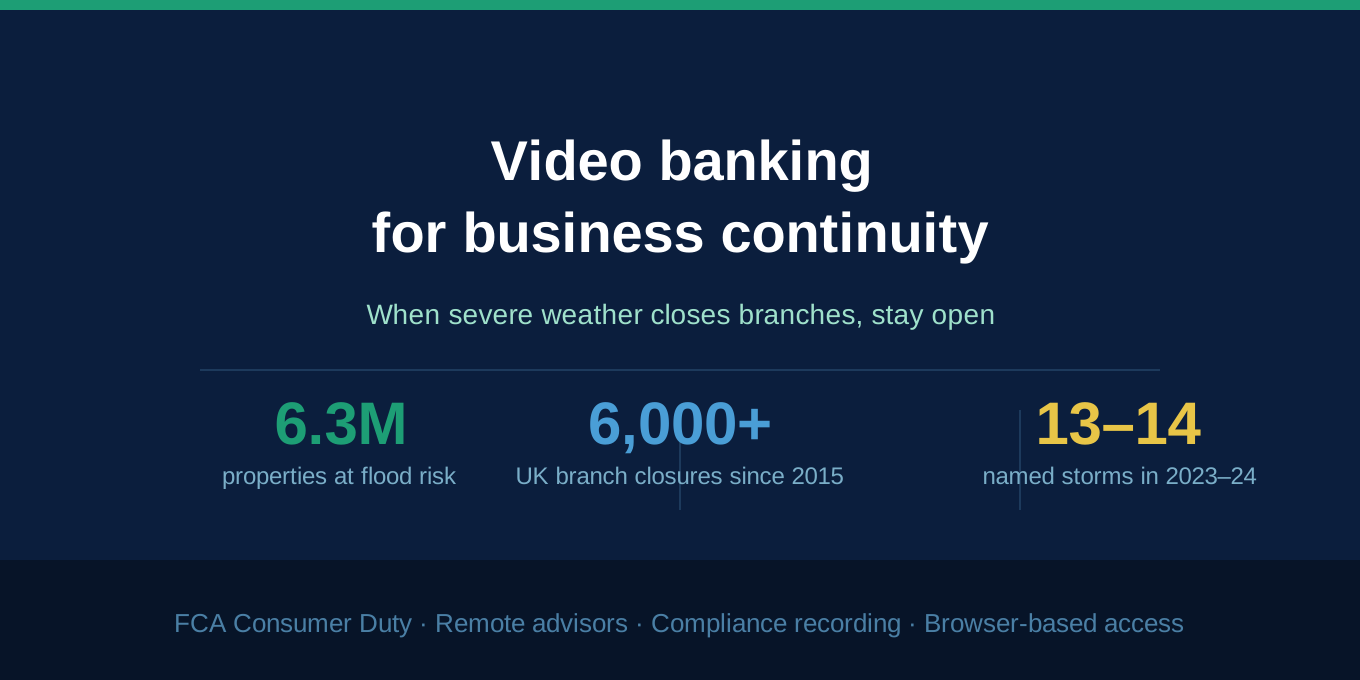
The numbers on flood risk alone should focus minds in any bank boardroom. The Environment Agency’s 2024 national assessment found that around 6.3 million properties in England are currently in areas at risk of flooding from rivers, the sea, or surface water. With climate change factored in, that number could rise to around 8 million, or one in four properties in England, by the middle of this century.
Storm Henk in January 2024 triggered more than 300 flood warnings from the Environment Agency and caused a major incident to be declared in Nottinghamshire. Storm Bert in November 2024 brought widespread flooding across Wales and southern England. Storm Darragh, which followed just two weeks later, left around 95,000 properties in Wales without power and caused widespread rail closures across England. In the winter period of 2023 to 2024, the UK was hit by 13 to 14 severe named storms.
This is not a freak year. This is the new pattern.
What Happens to Banking When a Branch Closes Unexpectedly?
Banks already face a structural branch access problem quite apart from weather. The UK has seen thousands of branch closures over the past decade, with over 6,000 bank and building society branches having closed since 2015. There were 432 closures in 2025 alone, with 42 parliamentary constituencies now having no bank branch left at all.
Severe weather does not close branches in areas where they already exist in good numbers. It closes branches in places that are already underserved. Rural towns. Coastal communities. Older populations who rely more heavily on face-to-face service. When those branches close because of a storm, flooding, or snow, there is often no nearby alternative.
And the timing could not be worse. Natural disasters and severe weather events are exactly the moments when people most urgently need their financial institution. They need to access emergency funds. They need to defer mortgage payments or speak with someone about a missed direct debit. They need to report a fraudulent transaction they spotted that morning. They need a real human being to talk to, not an automated FAQ page.
Phone lines get overwhelmed. Wait times go through the roof. Online portals handle transactions but cannot handle conversations. And the customer who needed help at their most vulnerable moment goes away feeling abandoned.
That is a retention risk. It is also just the wrong thing to do.
Why Video Banking Is the Business Continuity Layer Banks Are Missing
Business continuity planning in UK banking has traditionally focused on things like data backup, payment system redundancy, and operational resilience in IT infrastructure. These things matter enormously. But there is a gap in most continuity plans: what happens to the human layer of banking when a branch goes dark?
Video banking fills that gap directly. When a branch is closed, a customer with internet access and a device can connect to a trained banking advisor via video within seconds. Not an automated chatbot. Not a recorded message. A real person who can see them, understand their situation, and actually help.
This is not a theoretical capability. It is live, deployed technology used by financial institutions today. VideoCX.io’s video banking and video branch platform is built specifically for this: connecting customers to expert advisors across more than 44 product journeys and 400 banking service types, without any requirement to visit a physical location.
The question for UK banks is not whether video banking is technically possible. It is whether they have built it into their continuity planning as a genuine first-response channel, not an afterthought.
The Three Moments Where Video Banking Matters Most in a Crisis
1. Immediate Access During a Closure Event
When a storm closes a branch with little or no warning, customers who were planning to come in that day need an alternative immediately. A properly implemented video banking channel can absorb a significant portion of that demand.
Not every customer need requires a physical interaction. Most day-to-day banking queries, from balance checks and payment concerns to account updates and product questions, can be handled entirely over video. Smart routing means the customer gets to the right specialist for their need in seconds, not minutes. No rescheduling. No callback. No waiting.
Pre-call instructions can be dynamically tailored to the situation. If a flood event is affecting a specific region, the messaging shown to customers before they connect can acknowledge the situation and set appropriate expectations. That kind of thoughtful detail is what turns a channel into a trusted service.
2. Supporting Customers in Financial Distress
Flooding, storm damage, and severe weather events frequently leave people in urgent financial situations. Mortgage deferrals. Emergency withdrawals. Insurance claims. Payment freezes. These are not simple transactions. They involve sensitive conversations, identity verification, document review, and in many cases, decisions that need to be made with care and empathy.
A phone call handles some of this. But a video call does it better. The advisor can see whether the customer is distressed. They can share their screen to walk through options. They can complete necessary identity checks live on call. And the customer feels seen in a way that a voice call simply cannot replicate.
This is also where compliance matters. Every such conversation in a regulated environment needs to be recorded and stored. A purpose-built video banking platform handles this automatically, creating a full audit trail without manual effort, protecting both the customer and the bank.
3. Reaching Vulnerable and Rural Customers
The customers most affected by branch closures in severe weather are often the customers least able to navigate digital alternatives independently. Older customers. Customers in rural areas with limited transport. Customers with accessibility needs.
Video banking, particularly when it can be accessed from a browser without requiring a specific app download, removes most of the friction for these groups. A customer who struggles to travel can connect from home. A customer unfamiliar with mobile banking apps can access service from any browser without logging in or downloading anything.
Allowing customers to initiate a video call from a browser rather than within a specific app increases video banking adoption significantly. When accessibility is built into the channel design, the people who need it most can actually use it.
What Good Business Continuity Through Video Looks Like in Practice
Imagine a scenario: Storm forecast warnings are issued for a region on a Wednesday afternoon. A bank’s operations team knows that several branches will be unable to open on Thursday.
With a properly integrated video banking platform:
By Wednesday evening, an automated communication goes out to customers in affected postcodes, letting them know their branch will be closed and directing them to the video banking service with a single link.
On Thursday morning, increased call volume is automatically managed through intelligent queue distribution. Customers are matched to the most relevant advisor for their query. No one sits waiting in a general queue for forty minutes. An emergency fund transfer, a mortgage deferral conversation, an account unlock, a document upload for an insurance claim: all of these happen over video, with the same compliance recording and system integration as any branch interaction.
Behind the scenes, every call is logged. Every document shared is synced back to the core system. Live dashboards show the operations team exactly where demand is peaking, which product journeys are busiest, and whether any customers are dropping off without being helped.
And critically, if a video connection drops because a customer’s internet is also affected by the weather, parallel chat keeps the session alive. The customer and advisor can reconnect on video in the same session rather than starting over.
Identity Verification and Compliance Cannot Be an Excuse
One reason banks sometimes hesitate to push more service onto video channels is the question of compliance. How do you verify who you are talking to? What about KYC obligations? What about FCA requirements around recording and documentation?
These are fair questions, and they have good answers when you are using a platform that was designed for regulated financial services rather than adapted from a generic video conferencing tool.
Video KYC is a live, compliant identity verification process that can be completed entirely within a video session. The customer presents their documents on camera. The advisor confirms their identity in real time. The session is recorded, time-stamped, and stored. For customers whose circumstances have changed or whose identity needs refreshing, this can happen during the same call as any other service need.
During a major weather event, when large numbers of customers suddenly need to access services remotely and potentially need new processes set up, video KYC enables the bank to onboard and verify customers at scale without them ever needing to set foot in a building. That is not a workaround. That is genuine operational resilience.
The Agent Side of the Equation
Business continuity is not just about customers. It is also about the people serving them.
When a branch closes, the staff who work there often cannot reach the building either. A video banking platform that supports fully remote operation means those advisors can work from home and continue serving customers without any break in service.
This is not as simple as just using a video call app. Advisors working on regulated conversations need guidance on each screen, access to customer data, the ability to handle documents and share screens, and tools to manage multiple customers efficiently. The right platform provides all of this.
Timer features help advisors manage call duration. Customer history and previous interaction data is surfaced before the call starts. Advisor instructions on each screen mean less fumbling and more helping. These are the small details that make the difference between a chaotic emergency response and a confident, professional service experience.
The Vulnerability That Does Not Get Discussed Enough
There is a conversation happening in UK financial services about vulnerable customers, and it is long overdue. The FCA has made clear through its Consumer Duty requirements that banks must deliver good outcomes for all customers, including those who are less digitally confident, those with health challenges, and those in financial difficulty.
Severe weather events disproportionately affect exactly these groups. Older homeowners in flood-prone areas. People with disabilities who cannot easily travel. Customers in low-income households who cannot afford delays to urgent financial requests.
Video banking is not a luxury service for digital-forward customers. When designed and implemented properly, it is an accessibility tool. The same channel that serves a tech-savvy thirty-year-old transferring funds on a stormy Tuesday morning can support a seventy-five-year-old who needs help understanding a mortgage deferral request from their living room while floodwater rises outside their window.
The bank that can genuinely serve that customer, in that moment, will be remembered for it.
Beyond Crisis: Why Business Continuity Investment Pays All Year Round
Video banking infrastructure built for severe weather continuity does not sit idle the rest of the year. This is one of the most important arguments for investing in it properly.
A platform with 44 built-in product journeys supports everyday banking needs: new account openings, loan advisory, credit verification and assessment, wealth management consultations, and cross-selling conversations. Advisors using the platform every day become confident in it. Customers who use it for a routine query are already set up when they need it urgently.
Business continuity is not a mode you switch into when disaster strikes. It is a byproduct of building a resilient, accessible, human-centred service channel that runs all the time.
The banks that will handle the next Storm Henk best are not the ones who build an emergency video plan in response to it. They are the ones who already had video banking embedded in their service model before it arrived.
FCA Consumer Duty: The Regulatory Context That Makes This Urgent
The FCA’s Consumer Duty, fully in force for ongoing products since July 2023, sets a high bar. Banks must take reasonable steps to ensure customers can access products and services without unnecessary friction. They must consider the needs of customers in vulnerable circumstances. They must demonstrate good outcomes rather than just good processes.
A bank whose branch closes in a flood and whose only fallback is an overloaded phone line and a generic website is not meeting that standard. Not for everyone. Not for the customers who need them most.
Video banking, properly integrated and genuinely accessible, is part of what meeting Consumer Duty actually looks like in practice. It is not just a nice feature. It is increasingly part of the answer to how financial institutions demonstrate they are genuinely there for their customers.
What to Look for in a Video Banking Platform for Business Continuity
Not all video platforms are equal. If you are evaluating options with business continuity in mind, the features that matter most are:
Browser-based access: Customers should not need to download an app to connect. A link should be enough.
Smart routing and queue management: When demand spikes unexpectedly, intelligent distribution prevents chaos and ensures customers get to the right advisor fast.
Compliance recording built in: Every conversation in a regulated context needs to be stored. This cannot be an add-on.
Parallel chat for connection resilience: If the video drops during a storm, the session should survive. Customers should be able to reconnect without starting over.
Remote advisor capability: Your team needs to be able to work from home on the same platform with the same quality of service. A crisis does not care where your staff are sitting.
Integration with core systems: Advisor notes, customer data, documents, and call recordings should sync automatically. Manual data entry during a crisis is a reliability risk.
Pre-call dynamic instructions: When customers connect during an unusual event, they should receive context-relevant guidance before the call begins.
These are exactly the capabilities built into VideoCX.io’s insurance and financial services platform, designed from day one for the specific demands of regulated financial conversations at scale.
The Bottom Line
The UK is getting stormier. Bank branches are getting fewer. Customer expectations are getting higher. And the regulator is asking banks to demonstrate that they genuinely serve everyone, not just the customers who can easily walk through a door on a dry Tuesday afternoon.
Video banking is not a response to this challenge. It is the response to this challenge. A properly built, compliantly designed, human-centred video channel that works from any browser, routes customers intelligently, records everything it should, and can absorb a sudden spike in demand when the next named storm rolls in from the Atlantic.
The banks that have invested in this properly will not be writing apology letters to customers next winter. They will be serving them.
Ready to see how VideoCX.io can support your bank’s business continuity strategy with enterprise-grade video banking?
Book a demo with VideoCX.io and we will walk you through exactly how the platform handles high-demand scenarios, remote advisor workflows, compliance recording, and seamless customer journeys across all your service needs.