




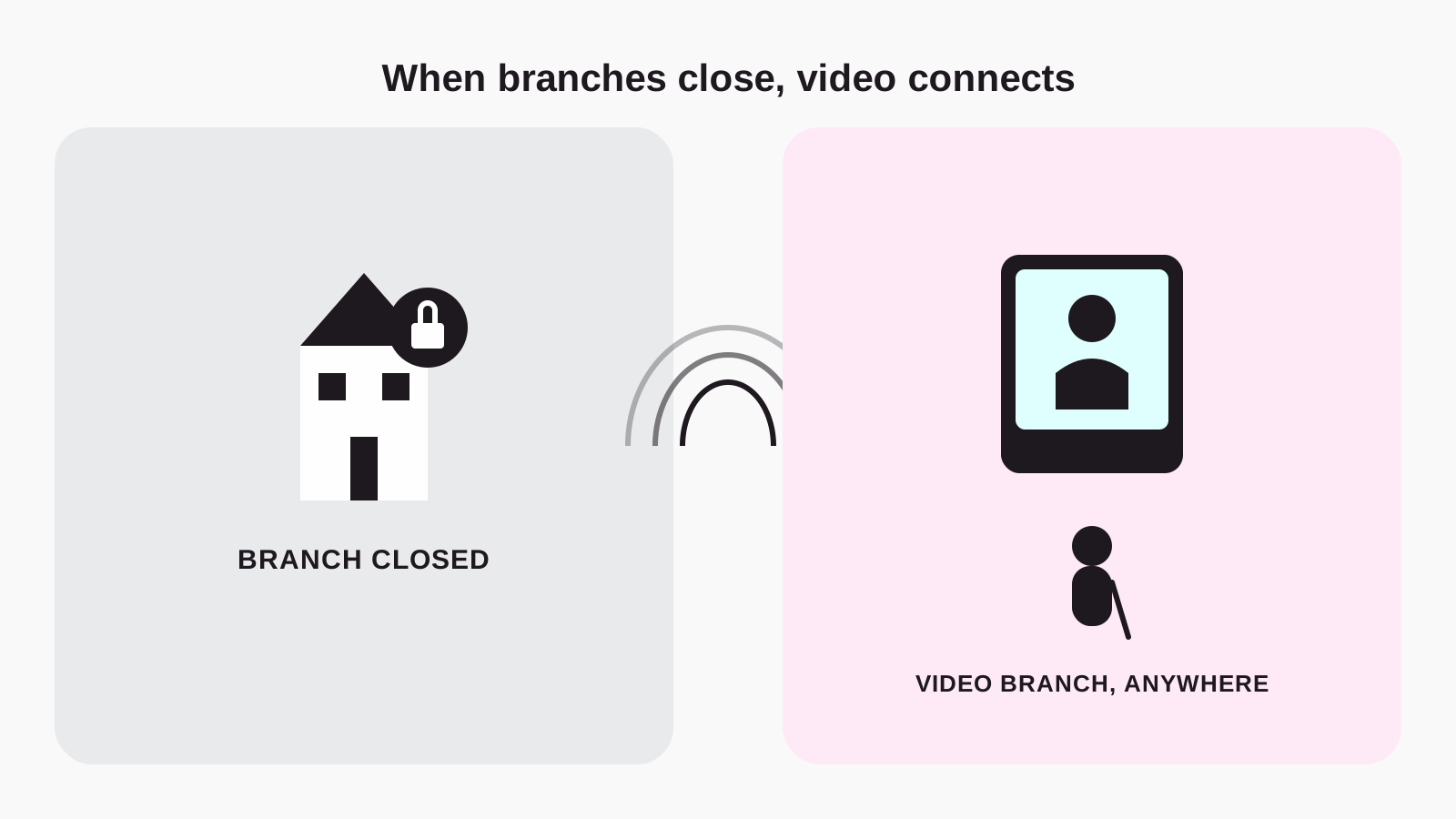
Walk into any town in England today and the pattern is familiar. A closed-down building society branch. A handwritten notice taped to the glass. A phone number. Maybe a QR code.
For a 72-year-old member in rural Shropshire who has held a savings account with the same society for 40 years, that QR code is not a solution. It is a door slammed shut.
Banks and building societies closed 6,161 branches between January 2015 and September 2024. Only 38% of the branches that were open ten years ago remain open today. And while building societies have held their ground better than the high street banks, they now operate approximately 1,300 branches, holding a 30% share of branches across the UK, down significantly from what communities once had.
The problem is not the closures alone. The problem is who gets left behind.
Four in ten older people with a bank account in Britain, roughly 4.09 million people, are not managing their money online and could be at high risk of financial exclusion. Three quarters of over-65s still want to carry out at least one banking task in person, at a branch, building society, or post office. These are not people who are being dramatic about change. These are people whose needs are not being met.
Building societies exist because of their members. Their whole purpose, their entire legal structure, is built on that relationship. So when a branch closes, the question should not simply be “where do they go?” It should be “how do we stay with them?”
This is where video changes everything.
Why Older Members Are Not Just a Niche Concern
Before getting into the how, it is worth being clear about the scale of the problem.
More than one in three people aged 65 and over, around 4.7 million, lack the basic skills to use the internet successfully. Around 2.3 million over-65s do not use the internet at all, and almost half of those are aged 75 and above.
88% of people aged 66 and over believe that banks should be forced to retain more physical branches. 78% of that same group believe the increasing digitalisation of society is already marginalising older people.
Nearly a third of older people with a bank account feel uncomfortable with online banking, with many citing fears of scams as a key reason.
These are not edge cases. They are the core membership of most UK building societies. Older members typically hold the larger savings balances. They hold ISAs, bonds, and mortgages that have been in place for decades. They are often the most loyal, the most trusting, and the most vulnerable.
And right now, many of them are being told to “use the app.”
What Video Banking Actually Is (And What It Is Not)
Let’s be clear about what we mean by video banking, because there is often confusion.
Video banking is not a video call to a call centre where someone reads from a script. It is a structured, secure, face-to-face interaction between a member and a qualified adviser, conducted over video, with the same capabilities as a branch visit.
That means the adviser can see the member. The member can see the adviser. Documents can be shared on screen. Identity can be verified. Accounts can be discussed in full. Mortgages can be reviewed. Complaints can be logged. All without the member leaving their home.
A properly built video branch platform does not feel like a workaround. It feels like a branch that came to you.
For an 80-year-old who cannot drive to the nearest remaining branch, that difference is enormous.
The Five Ways Video Serves Aging Members That Nothing Else Can
1. It Recreates the Face-to-Face Relationship
The most consistent finding in research on older banking customers is that they want to speak to a real person. Not a chatbot. Not an automated phone system. A person they can see.
Banks can now replicate the face-to-face interactions that elderly members value, remotely. They can enable members to see and compare product information, sign and exchange documentation, and verify their identity online, as though they are in a branch.
A voice call gives you audio. A video call gives you everything that makes a human conversation actually work: facial expressions, eye contact, the ability to see whether someone has understood what you just said. For an older member discussing a complex financial matter, that difference is not small. It is the whole thing.
2. It Removes the Travel Barrier Without Removing the Human Touch
For many older members, the issue is not digital exclusion in the abstract. It is physical inaccessibility in the concrete.
Cuts to bus services in particular make it hard to access the nearest remaining branch, even if the geographical distance is not enormous. For members with mobility issues, health conditions, or who live in rural areas, getting to a branch is not just inconvenient. It can be genuinely impossible on certain days.
Video brings the branch to the member’s living room. The adviser appears on the screen. The conversation happens in a familiar, safe environment. There is no commute, no waiting in a queue, no needing to find a seat because your knees are bad.
For building societies committed to member welfare, this is not a nice-to-have. It is a responsibility.
3. It Supports Financial Decisions That Require Explanation
Not all banking tasks are the same. Checking a balance is simple. Choosing between a fixed-rate bond and an easy-access ISA is not. Discussing equity release options is not. Understanding what happens to a joint account when a spouse dies is absolutely not.
People need specialist advice, and limiting the number of in-person banks and building societies only makes this more difficult to access. People may need help in deciding which type of savings or current account to open in the first place. This kind of advice needs to remain available face-to-face.
Video is the only digital channel where an adviser can genuinely walk someone through a complex decision. They can share their screen to show product comparisons. They can slow down, repeat themselves, and check understanding. They can see if the member looks confused. These are things you simply cannot do on a phone call or in an email.
4. It Reduces Vulnerability to Scams
This is a point that rarely gets enough attention.
31% of older people who are uncomfortable with online banking cite fears of scams as a key reason for their discomfort. And they are right to worry. Authorised push payment fraud, where someone is tricked into transferring money, disproportionately affects older customers.
A secure video banking channel with proper identity verification gives members a safe, verified route to interact with their building society. When a member knows what a genuine video call from their society looks like, they are far better placed to spot a fake one.
Proper video-based identity verification also protects the society. When a member opens an account or changes personal details via video, there is a clear, auditable record of who authorised the change and what was said. That protection runs both ways.
5. It Scales Without Losing Personalisation
One of the practical challenges building societies face is staffing. A branch with three advisers can serve the local community. But as branches close and member needs are rerouted to a shrinking number of physical locations, those advisers become a bottleneck.
Video solves this in a way the phone cannot. A video adviser can serve members from any location. The society’s best mortgage specialist does not need to be physically present in every town to serve members in those towns. They can be available on screen, on demand, with all the warmth and clarity of a real appointment.
The result is not a worse experience than a branch. For many older members, it is a better one, because they are getting access to specialists they would never have been matched with locally.
Addressing the “But They Don’t Use Technology” Objection
This is the most common pushback, and it is worth addressing directly.
The concern is that video banking requires a device and a connection, and many older members have neither the equipment nor the confidence to use it. This is a legitimate concern. But it is not an argument against video banking. It is an argument for how video banking needs to be introduced.
A few things matter here.
First, video works on a tablet. A basic, large-screen tablet with a simple video app is far more accessible than a full banking app. The interface can be designed for clarity. The text can be large. The buttons can be obvious. Good video banking platforms are built with accessibility in mind.
Second, the first contact does not need to be video. A phone call to set up the first video session, with a family member or carer present if the member prefers, can serve as a bridge. Building societies can run simple familiarisation sessions for older members who want to try video before they need it.
Third, the alternative is not “they use the branch.” The branch is already gone. The alternative is that they struggle alone, or they rely entirely on family members to manage their finances for them. Neither outcome serves the member’s dignity or their financial health.
The Regulatory Dimension
Building societies in the UK operate under the FCA’s Consumer Duty, introduced in 2023. Consumer Duty requires firms to actively support good outcomes for all customers, including those in vulnerable circumstances.
Older members who have lost access to their local branch are precisely the group Consumer Duty was written to protect. A building society that replaces a branch with a phone number and a link to an app, and does nothing more, is unlikely to be meeting its obligations under that framework.
Video banking, properly implemented, is not just good practice. It is a documented, auditable way of demonstrating that the society continued to serve its most vulnerable members when the physical branch was no longer available.
For compliance and governance teams, that audit trail has real value. For credit verification processes conducted via video, the same logic applies: a secure video interaction creates a verifiable record that protects both member and institution.
What Good Video Delivery Looks Like in Practice
Here is what a well-implemented video member service actually looks like for a building society:
Scheduled appointments: A member calls the society or books online. An appointment is set for a video call with a named adviser. The member receives a simple link by text or email, and clicks it at the agreed time.
Walk-in equivalent: For members who prefer not to wait, a virtual queue allows them to join a live video session with the next available adviser, mirroring the experience of walking into a branch.
Complex case handling: Mortgage reviews, bereavement support, ISA rollovers, and power of attorney queries are handled by specialist advisers via video, with document sharing and on-screen guidance throughout.
Identity verification: Newaccounts, large transactions, and sensitive account changes are verified through a secure video identification process that meets FCA and anti-money laundering requirements.
Post-call follow-up: A summary of what was discussed and agreed is sent to the member after the call, in plain language, so they can review it at their own pace.
None of these steps are complicated. All of them require investment in a platform that is built for financial services, not adapted from a consumer video tool.
Building Societies Have a Unique Opportunity Here
The big banks are moving to digital at pace. Their older customers are being swept along in that current, or left behind entirely.
Building societies are different. They are owned by their members. Their purpose is not shareholder return. It is member service. That distinction matters enormously in this context.
Many building societies are not only committed to keeping their local branch networks open, but are actively looking to expand them. Newcastle Building Society has deliberately opened new branches in towns where the last bank had shut its doors, making a physical commitment to communities that would otherwise be left without access.
Not every society can open branches in every town. But every society can have a video channel that functions like a branch. And for the members who most need it, a high-quality video service, staffed by people who know them, who take time with them, and who can handle the full range of their financial needs, is a genuine replacement for what the physical branch provided.
This is one of the clearest ways a building society can demonstrate that it is different from a bank. Not just in legal structure, but in lived experience for its members.
Frequently Asked Questions
Is video banking secure enough for financial advice?
Yes. Enterprise-grade video banking platforms use end-to-end encryption, secure authentication, and full session recording, meeting FCA and AML standards. They are specifically built for regulated financial services, not adapted from consumer tools.
What if my older member does not have a device?
Many building societies support this through in-branch device familiarisation sessions before branches close, partnerships with local libraries or community groups, or by enabling a family member or carer to sit in on calls. The goal is to meet the member where they are, not to demand they come to a new technology.
Does video banking reduce costs compared to branch operations?
Yes. Advisers serving members via video can handle more appointments per day without being tied to a single location. Specialist advisers can cover multiple geographies. Over time, video banking reduces the cost of serving each member while maintaining quality.
What types of queries can video banking handle?
Video is suitable for almost everything that would have been handled in a branch: account queries, savings and ISA advice, mortgage reviews, bereavement support, complaints, new product discussions, identity verification, and credit assessments.
Is video banking relevant only for older members?
No. Younger members with busy schedules increasingly prefer video appointments to branch visits too. The investment serves the whole membership base. But for older members who have lost branch access, it is the most meaningful service a society can offer.
Does a video service satisfy Consumer Duty requirements?
A well-implemented video service, with clear accessibility provisions and documented outcomes, provides strong evidence of Consumer Duty compliance for members in vulnerable circumstances. Societies should document how video was offered, accessed, and used.