






Trust is invisible. You cannot put it in a product spec. You cannot measure it in a dashboard. And yet, it is the single most important factor determining whether a customer completes a mortgage application, shares sensitive financial details, or simply hangs up and calls a competitor.
Banking has always been in the trust business. The marble floors, the pinstripe suits, the heavy oak desks: none of that was accidental. Every element was designed to signal permanence, authority, and safety.
Then came digital banking. The marble floors disappeared. And with them, so did many of the unconscious trust signals customers had relied on for decades.
Video banking brings the human element back. But here is what most banks miss: putting a face on screen does not automatically create trust. The psychology is far more nuanced than that. And behavioral finance gives us the language to understand exactly why.
Why Trust in Financial Services is Not Rational
Before we get into video specifically, we need to understand something important.
Customers do not make financial decisions rationally. None of us do.
This is the central lesson of behavioral finance, a field that combines psychology and economics to explain how people actually behave with money, as opposed to how traditional theory assumes they should. Daniel Kahneman, Amos Tversky, and Richard Thaler spent decades proving that human financial decisions are driven far more by emotion, habit, and cognitive shortcuts than by careful analysis.
For banks, this has a very specific implication.
Customers do not evaluate whether their bank is trustworthy by reading the fine print. They decide in seconds, based on how a conversation feels, how easy a process seems, how confident their agent sounds, and whether the interaction matches the mental picture they have of what a “safe” financial relationship looks like.
That means every element of a video banking interaction is a trust signal. And most banks are not managing those signals deliberately at all.
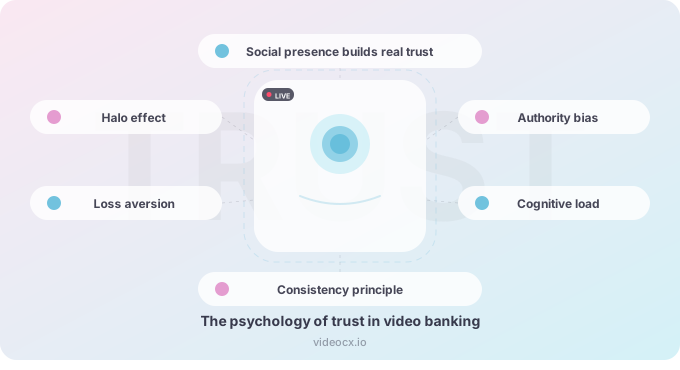
1. Social Presence Theory: Why Seeing a Face Changes Everything
The first piece of behavioral science that explains video banking’s power is Social Presence Theory.
Developed by Short, Williams, and Christie in the 1970s, the theory describes how the feeling of “being with another person” changes depending on the communication medium you are using. Computer-based communication is lower in social presence than face-to-face communication, but different computer-based communications can affect the levels of social presence between communicators and receivers.
In practical terms, the ranking looks roughly like this:
- In-person conversation: highest social presence
- Video call: high social presence
- Phone call: moderate
- Live chat: low
- Email: lowest
This matters enormously for banking trust.
When a customer discusses something as sensitive as a loan, a bereavement, or a potential fraud, they are carrying real emotional weight into the conversation. Social presence was positively associated with trust, enjoyment, and perceived usefulness, which led to greater purchase intentions. In banking terms, this translates directly into a customer who feels more comfortable disclosing their full financial situation, asking the questions they are actually worried about, and following through on the decisions they need to make.
A phone call cannot fully replicate this. A chatbot certainly cannot.
Video gets closest to in-person, without requiring a branch.
This is why the video branch model is not simply a convenience feature. It is a trust architecture decision. When banks give customers a real face to interact with, they are activating psychological mechanisms that have built human trust for thousands of years: eye contact, facial expression, shared attention, and what researchers call immediacy cues.
These are not minor details. Immediacy has been identified as nonverbal communication behaviors such as eye contact and body movements that can enhance closeness in interactions. These are the signals that make a customer think, consciously or not: “This person is real. This institution is real. I am safe here.”
2. The Halo Effect: Your Agent’s First Impression Is a Financial Decision
Here is something that should make every bank take its agent presentation standards more seriously.
Customers decide whether to trust your agent within the first few seconds of a video call. And that judgment colours every single thing that follows.
This is the Halo Effect, first identified by psychologist Edward Thorndike in 1920. The halo effect is a cognitive bias that claims that positive impressions of people, brands, and products in one area positively influence our feelings in another area.
In a video banking context, this plays out in a very specific way.
A customer who sees an agent who appears confident, well-presented, and calm in the first ten seconds will unconsciously extend that positive impression to their perception of the agent’s competence, honesty, and the reliability of the advice they are about to give. The reverse is equally true.
The first moments of any meeting, sales call or presentation are extremely critical and should not be left to chance. Three aspects of first impression are particularly important: looks, likeability, and confidence.
For banks, this has direct operational implications:
- Agent background matters. A cluttered or unprofessional backdrop creates a negative halo that contaminates the entire interaction.
- Lighting matters. A poorly lit face reads as low-quality and, by psychological extension, low-trust.
- Tone in the first thirty seconds matters more than anything said in the following ten minutes.
In the financial services sector, the Halo Effect can influence investment decisions and financial planning. Positive experiences with financial advisors can lead clients to trust their advice and remain loyal to the firm. Renascence
Banks that invest in agent presentation standards, proper equipment, and structured opening scripts are not being pedantic. They are managing the Halo Effect deliberately, which directly affects whether customers trust the advice they receive.
3. Loss Aversion: The Fear That Sits Behind Every Digital Banking Interaction
Kahneman and Tversky’s most famous contribution to behavioral finance is Prospect Theory, which showed that people feel losses roughly twice as intensely as they feel equivalent gains.
In plain terms: losing £100 hurts about twice as much as gaining £100 feels good.
For digital banking, this has a critical implication that is often underestimated.
Every time a customer enters a digital financial interaction, a part of their brain is scanning for risk. Not consciously. But the fear of being defrauded, of making the wrong decision, of being exposed, is running quietly in the background.
This is not paranoia. It is warranted.
Industry body UK Finance estimates that criminals successfully stole £1.17 billion through banking fraud and scams in 2024. British customers are acutely aware of financial fraud. And that awareness heightens loss aversion during any interaction that feels uncertain, unclear, or unfamiliar.
Video banking addresses loss aversion in a way that no other digital channel can.
When a customer can see a real person, verify their identity visually, and watch their expressions in real time, the unconscious fraud scanner quiets down. The sense of accountability increases. The feeling of safety goes up.
This is why credit verification via video works so effectively. The visual layer adds a layer of mutual accountability that a phone call or a form submission simply cannot provide. The customer can see who they are dealing with. And that visibility fundamentally changes their perception of risk.
For banks designing video workflows, the practical lesson is this: do not treat the opening moments of a video call as administrative. They are the period during which the customer’s loss aversion either settles or spikes. Everything you do to make that opening clear, calm, and professionally structured is doing psychological work that determines how the rest of the conversation unfolds.
4. Cognitive Load: Why Complexity Destroys Trust
There is a common mistake banks make when designing digital interactions: they assume that more information equals more confidence.
It does not.
Cognitive load theory tells us that the human brain has a limited capacity to process information at any one time. When that capacity is exceeded, the quality of decision-making drops, emotional discomfort rises, and the person starts looking for the exit.
According to research, cognitive overload can increase the dependence on heuristics and hinder logical reasoning, resulting in less-than-ideal financial judgments. Technology adoption is also significantly influenced by customers’ perceptions of usefulness, danger, and trust, particularly in high-stakes situations.
In banking terms, this means a customer who is confused is also a customer who is anxious. And an anxious customer is not a trusting one.
The most common cause of friction is too many choices or unclear expectations. Strong CX design simplifies decision-making by clearly defining requirements, setting expectations upfront, and minimizing ambiguity throughout the customer journey.
Video banking can either reduce cognitive load or dramatically increase it. The difference is entirely in the design.
A video session that requires customers to toggle between screens, re-enter information they have already provided, or wait with no explanation for what is happening next will generate anxiety that poisons the trust of the entire interaction.
Conversely, a well-designed video banking experience actively reduces cognitive load:
- The agent guides the customer through each step verbally, removing the need to read instructions independently
- Documents and forms are walked through in real time using co-browsing tools, so the customer is never left to figure something out alone
- Custom workflows built into the video session mean the agent never has to ask the customer to wait while they navigate between systems
- Smart customer routing ensures customers arrive at the right agent for their query the first time, without being passed between departments
Each of these design decisions is doing behavioral science work. They are reducing the mental effort required of the customer, which directly reduces anxiety, which directly increases trust.
When customers understand the purpose of data sharing, when language is simple, and when the design reduces friction, they feel more comfortable. Complicated login steps, inconsistent authentication patterns, or confusing identity checks can create immediate uncertainty.
5. Authority Bias: Why the Visual Signal of Expertise Builds Trust
Behavioral finance identifies authority bias as our tendency to trust the judgments of people who appear to be credible experts in their field.
This is why your GP wearing a white coat still matters. It is why financial advisers typically dress in formal attire. The visual signals of competence and authority are not superficial: they activate a psychological shortcut that tells our brain “this person knows what they are doing.”
Video banking puts authority signals back into financial services in a way that text-based digital channels cannot.
An agent who is well-presented, speaks clearly about the customer’s specific situation, and can share relevant documents or screens in real time is communicating expertise visually and verbally simultaneously. This stacks trust signals in a way that a chatbot, an email, or even a phone call simply cannot match.
A successful service relationship is determined by its ability to act on the expectations of the customer, and most importantly by the feeling of trust and social exchange which can only be achieved through continuous relationship-building in a human-to-human context.
For more sensitive financial products, the authority bias effect is even more pronounced. A customer discussing insurance policy servicing or a complex product review will extend far more trust to a knowledgeable agent they can see than to a voice on a phone or a sequence of instructions on a screen. This is exactly why video-based insurance policy servicing performs so strongly: the authority signals inherent in a face-to-face format make customers significantly more receptive to guidance.
6. The Consistency Principle: Trust Is Built by What Happens After the Call
One final behavioral principle that banks often overlook: trust is not just built during the interaction. It is confirmed or destroyed by what happens next.
Robert Cialdini’s consistency principle describes our deep psychological need for our experiences to be coherent. When something feels different from what we expected, it creates dissonance. That dissonance erodes trust.
For video banking, this means the interaction record, the follow-up, and the service delivered after the call all become part of the trust architecture.
A customer who has an excellent video session and then receives a confusing follow-up email, or discovers that information discussed on-screen was not captured correctly, will feel a jarring inconsistency. The trust built during the call collapses.
This is why dashboards and reporting tools are not just operational features. They are trust infrastructure. When the interaction record is complete, accurate, and traceable, the bank can deliver on what was discussed. And when you consistently deliver on what was discussed, you build the kind of trust that turns a one-time video customer into a long-term relationship.
The Behavioral Blueprint: What This Means for UK Banks
Pulling all of this together, behavioral finance gives us a clear blueprint for how trust works in video banking.
It is not about having good technology. It is about understanding that every element of the video experience is sending psychological signals to the customer’s brain. Those signals are either building trust or eroding it.
The banks that understand this are not simply deploying video as a channel. They are designing it as a trust system, from the routing decisions that ensure the right customer reaches the right agent, to the agent’s opening seconds on screen, to the workflow that reduces cognitive load mid-session, to the record that confirms everything afterwards.
This is not soft psychology. It is competitive strategy.
In a market where fraud and scams stole £1.17 billion from UK consumers in 2024 and customers are more risk-conscious than ever, the institution that makes people feel genuinely safe, seen, and understood will win. Not just the interaction. The relationship.
Video banking, done with an understanding of the behavioral science behind trust, is one of the most powerful tools available to UK financial services right now.
The question is not whether your bank will offer it. The question is whether you will design it in a way that the customer’s brain actually trusts.