





There is a quiet paradox sitting at the heart of UK banking right now.
Customers are logging into their banking apps more than ever. Branches are closing at a pace that would have seemed unthinkable fifteen years ago. Digital adoption figures look healthy on every dashboard.
And yet, if you ask customers how much they trust their bank, the answer is increasingly uncomfortable.
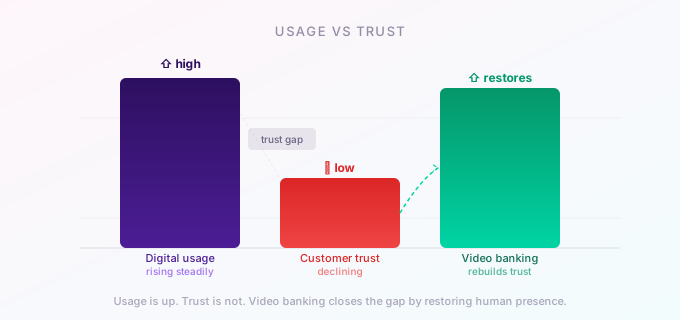
Usage is up. Trust is not.
Understanding why that gap exists, and what closes it, is one of the most important questions in UK financial services today. Because the banks that figure it out will not just score better on satisfaction surveys. They will win the relationships, the products, and the long-term loyalty that purely digital competitors are struggling to earn.
What Trust Actually Means in Banking
Before unpacking why trust is declining, it helps to be precise about what trust actually means in a banking context.
It is not the same as satisfaction. A customer can be satisfied with a quick payment transfer and still not trust their bank with a mortgage conversation.
It is not the same as loyalty either. Customers stay with banks for all kinds of reasons, inertia, direct debit complexity, joint accounts. That is not the same as trust.
Trust in banking is specifically about this: does the customer believe the institution has their interests at heart, will handle their money and data safely, and will show up properly when something goes wrong?
That kind of trust takes time to build and very little time to break.
The Branch Closure Effect
The most visible shift in UK retail banking over the past decade has been the rapid closure of physical branches.
Banks have justified this with usage data, and the numbers are real. Digital transactions have replaced in-branch visits at an extraordinary rate. From a cost perspective, the case for closure looks straightforward.
But what the usage data does not capture is what the branch was actually doing for customers beyond the transaction itself.
The branch was trust infrastructure.
It was a permanent address. It was staff who recognised you. It was a conversation where both parties were present and visible and accountable to each other. When something went wrong, you knew where to go and who to speak to.
When that disappears, something less tangible but equally important disappears with it. Customers do not just lose a place to do their banking. They lose the feeling of being known by their bank.
A significant portion of UK customers, particularly those dealing with complex financial decisions like mortgages, bereavements, business accounts, or fraud, still want that human element. Not because they are technophobic. Because the decision is serious enough to warrant it.
Closing the branch without replacing what it represented is not modernisation. It is trust erosion by another name.
The Automation Overreach Problem
Digital banking has delivered genuine convenience for straightforward transactions. Instant payments, balance checks, statement downloads: customers have accepted and welcomed these.
Where the trust problem begins is when automation is applied to interactions it was never equipped to handle.
Customers who contact their bank about a potential fraud case and reach a chatbot do not feel served. They feel dismissed. Customers who are navigating a bereavement and trying to manage a deceased family member’s accounts through an automated phone system do not feel supported. They feel abandoned.
The principle is simple: customers accept automation for simple tasks and reject it for complex or emotionally charged ones.
The problem is that many banks have not drawn that line carefully enough. In the drive to reduce servicing costs, automation has been extended into interactions where it actively damages the customer relationship.
The result is a customer who completes their simple transactions digitally without issue, but whose trust evaporates the moment they need something more. And those high-stakes moments, fraud, financial difficulty, major life decisions, are precisely the ones that define how a customer feels about their bank for years afterwards.
The Fraud Environment Is Making Customers Suspicious of Everything
Fraud in the UK is not a background issue. It is front page news, it is dinner table conversation, and it has made a large number of customers genuinely wary of digital banking interactions.
This is not irrational. Authorised push payment fraud, where customers are manipulated into sending money to fraudsters who impersonate their bank or other trusted organisations, has grown substantially. The sophistication of impersonation scams has reached a level where even financially literate customers have been caught out.
The knock-on effect is a baseline suspicion that now accompanies every digital banking interaction for a significant portion of UK customers.
When a customer receives a genuine message from their bank, their first instinct is to question it. When they are asked to verify their identity through a digital process, they wonder whether the process itself is legitimate. When they are completing a significant transaction online, a part of their brain is scanning for the signs of a scam.
That anxiety does not disappear between interactions. It accumulates. And it makes customers less likely to complete sensitive digital transactions, less likely to share data when prompted, and more likely to abandon an online process and seek a human instead.
No amount of security messaging or better UI design fully resolves this. Because the underlying issue is not that customers do not understand the security features. It is that they cannot see who they are dealing with.
IT Outages Are Turning Convenience Into a Liability
The promise of digital banking is that it is always available. When that promise breaks, the consequences for trust are disproportionately severe.
The UK has seen a string of high-profile banking IT failures in recent years. Outages on payday. Failed payment systems during tax deadlines. Customers locked out of their accounts for hours with no clear communication about when service would return.
Each failure does more than inconvenience customers in the moment. It plants a seed of doubt that grows over time.
A customer who cannot access their funds on payday does not forget that experience. A customer who tries to make a critical payment and finds the system down does not simply move on when it comes back up. They carry a version of that experience into every subsequent interaction.
The banks most exposed to this are those who have reduced or eliminated alternative channels. When a branch existed, an outage was a frustration. When the branch is gone and the app is down and the phone queue is two hours long, there is no safety net. The customer is simply stuck.
Reliability is not a technical metric. It is a trust metric. And right now, the UK banking sector’s reliability record is contributing to the trust gap in ways that many institutions have not fully acknowledged.
Why Video Reverses Every One of These Trends
Here is what is remarkable about this picture.
Every driver of declining trust has the same root cause: the removal of a human being from the interaction.
No branch means no face. Automation means no person. Fraud anxiety means no certainty about who you are dealing with. Outages mean no reliable human alternative when the digital channel fails.
Video banking addresses all of this at the root. Not by adding another digital feature, but by putting a real human back into the channel.
When a customer can see their banker, three things happen that no other digital channel can replicate:
Accountability is restored. Both parties are visible. Both parties know the interaction is recorded. The customer can see a real person, read their expressions, and hear their tone. The dynamic shifts from transactional to relational in a way that text or voice alone cannot achieve.
Fraud anxiety drops. The mutual visibility of a video interaction is itself a powerful reassurance. Customers are not wondering whether they are dealing with a legitimate representative of their bank. They can see them. That visibility changes the emotional register of the entire conversation.
Complex interactions become manageable. A customer navigating a mortgage, a bereavement, a fraud case, or a major financial decision can be guided through it by a person they can actually see. The agent can read the customer’s reaction in real time, adjust their approach, and deliver the kind of empathy and attentiveness that a phone call approximates but never fully delivers.
The Right Interactions Need the Right Channel
Video banking does not replace every digital channel. Nor should it.
The key is getting the right customer to the right channel for the right type of interaction. A balance query belongs in self-service. A mortgage conversation belongs on video. A fraud case belongs with a specialist agent, on video, where both parties are visible and the interaction is fully recorded.
Smart customer journey and routing makes this distinction automatically, so customers never have to figure it out themselves. They simply arrive at the right experience for their need.
When the routing is right, the video interaction itself needs to work flawlessly. A dropped connection or a clunky workflow at this point does not just create friction. It actively contradicts the trust signal the bank is trying to send. Custom video calling workflows built for financial services ensure the experience is seamless from start to finish.
Where Video Does Its Most Important Trust Work
There are specific interaction types where video does not just improve the customer experience. It fundamentally changes the trust dynamic.
For document-heavy interactions, the ability for an agent to walk a customer through what they are signing, in real time, on the same screen, removes one of the biggest sources of anxiety in financial services: the feeling of signing something you do not fully understand. Co-browsing on a live video call makes this possible in a way that feels natural and genuinely supportive.
For credit and verification processes, the visual layer adds structured accountability that transforms the customer’s experience of what is typically a stressful interaction. Video-based credit verification gives both parties a clear, auditable record and reduces the anxiety that sensitive financial conversations naturally carry.
For insurance customers, who typically experience policy servicing as impersonal and difficult to navigate, video-based insurance policy servicing turns a frustrating process into one that actually builds confidence and loyalty.
The Operational Layer That Makes It Sustainable
Rebuilding customer trust through video is not just about the individual interaction. It is about consistency at scale.
A customer who has an excellent video conversation and then receives a confusing follow-up or discovers that information discussed was not captured correctly will feel a jarring inconsistency. The trust built in the call collapses in the aftermath.
This is why real-time dashboards and reporting are not a nice-to-have. They are trust infrastructure. When operations teams have live visibility into interaction quality, compliance, queue depth, and agent performance, they can catch problems before they become patterns. They can ensure that what the customer experienced in the video call is matched by everything that follows.
Trust is built in moments. It is sustained by systems.
The Bigger Picture
The trust gap in UK digital banking is not going to close by itself.
Branch closures will continue. Automation investment will increase. The fraud environment is not going to improve significantly in the near term. And customers who have been let down by outages, chatbots, or impersonal digital processes will not simply forget.
What will close the gap is a deliberate decision to put human presence back into the digital experience at the moments that matter most.
Not for every interaction. For the right ones.
The banks that understand this distinction, and invest in video banking as a trust channel rather than just a convenience feature, will build something their competitors cannot quickly replicate. A customer base that does not just use their bank. That actually trusts it.
In a market where usage is easy to achieve and trust is increasingly hard to earn, that is a meaningful competitive advantage.
Video banking does not just reverse the trend. It creates the conditions for a fundamentally different kind of customer relationship.
One built on the thing that has always been at the heart of good banking. A real person, present and accountable, when it matters most.