





Most banks that try to scale video banking hit a wall.
Not because the technology fails them. Because the model behind it does.
They hire a few agents, plug in a conferencing tool, and call it video banking. Then volumes grow, queues back up, compliance flags appear, and the whole thing buckles under its own weight.
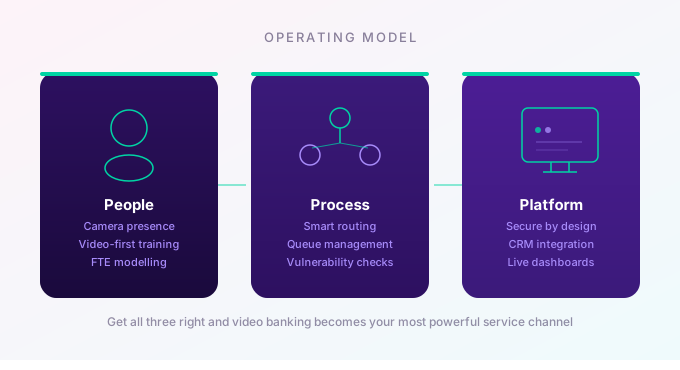
The banks that actually scale are thinking in three dimensions at once: the people running it, the processes holding it together, and the platform making it possible. Get all three right and video banking becomes one of the most powerful service channels you own. Get one wrong, and the other two cannot save you.
1. People: The Layer Most Banks Underestimate
The instinct is to take your best call centre agents and move them to video. Resist it.
Phone and video are not the same job. On a call, the customer cannot see your agent. On video, they can see everything: posture, hesitation, whether they glanced at a second screen. Opinions form in seconds.
The agents who thrive in video banking share three traits:
- Comfortable being watched and able to project calm under pressure
- Can hold a conversation while navigating systems at the same time
- Do not panic when technology misbehaves: dropped calls, frozen screens, customers who cannot find mute
That last one matters more than most people expect. How your agent handles those small disruptions determines whether the customer hangs up frustrated or actually feels reassured.
On training: standard product knowledge is table stakes. The real work is coaching on camera presence, managing silences (which feel longer on video than on the phone), and FCA-aligned compliance for recorded interactions.
On workforce planning: video calls run slightly longer than phone calls. Customers front-load more questions when they can see a human face. If you do not account for this in your FTE model, service levels will quietly drift.
2. Process: Where Most Operating Models Actually Break Down
Good processes in video banking cannot be copy-pasted from another channel. They need to be rebuilt with video in mind. There are four places where things tend to go wrong.
Routing
A balance query does not need video. A mortgage application, a bereavement conversation, or a complex fraud case probably does. If your routing logic is not making this distinction, you are wasting agent time and sending customers to a channel they did not need. Smart customer journey and routing is not a nice-to-have: it is the foundation everything else sits on.
Queue management
Customers expect video to feel like an in-branch appointment. They expect to be seen roughly when they were told they would be. If your system cannot show accurate wait times or offer a callback, you will lose them before the conversation even starts. Abandonment rates spike in ways that look confusing until you understand the expectation customers bring to a video channel.
Document handling
This is one of video banking’s biggest advantages over the phone: agents can walk customers through documents in real time, annotate on screen, and confirm understanding before anything is signed. Co-browsing on video call makes this seamless, but only if what is shared and captured sits correctly in the interaction record and meets Consumer Duty obligations.
Vulnerability identification
This is where UK banks face the sharpest regulatory scrutiny. The FCA expects firms to identify and appropriately support customers in vulnerable circumstances. Video gives you more signal than a phone call: you can see distress, confusion, or signs the person on screen is not the account holder. Your process needs to tell agents exactly what to do with that signal, clearly and quickly. Credit verification workflows can also layer in structured checks that reduce risk at exactly this point in the journey.
3. Platform: The Technology Has to Earn Its Place
Here is the counterintuitive truth: technology is the easiest part to get right, and the most common part to get wrong.
Banks either over-engineer the platform until it becomes a maintenance problem, or they bolt together consumer tools never designed for regulated financial services. Neither works at scale.
A platform built for video banking needs to do four things well:
Secure by design, not by configuration. End-to-end encryption, audit trails, access controls, and session recording need to be baked in. Not bolted on later. UK banks under FCA oversight cannot treat these as optional extras.
Integrated with what already exists. Your CRM, identity verification, and document systems should surface context automatically inside the video call. An agent toggling between five separate systems during a live interaction is an agent who will make mistakes. Custom workflows built into the video calling layer keep everything in one place.
Graceful under poor network conditions. Your customers are calling from home broadband, mobile data, and shared office Wi-Fi. The platform should lower video quality before it drops the call entirely, and should never lose the interaction record even if the session is interrupted.
Visible to your operations team. This is the piece most banks leave too late. Real-time dashboards and reporting give your team live visibility into queue depth, agent availability, quality scores, and compliance flags. Without this, you are managing video banking by instinct rather than data. And at scale, instinct is not enough.
Insurance and policy servicing is one area where this visibility matters most. Video-based insurance policy servicing creates a complete, auditable interaction record that protects both the customer and the firm.
Putting It All Together
The banks that make this work treat people, process, and platform as one system, not three separate projects.
When an agent spots a vulnerable customer, the process tells them what to do and the platform captures it. When volumes spike on a Monday morning, the workforce model flexes and the queue logic adapts. When a regulatory requirement changes, the update flows through training and into platform configuration.
That coherence does not happen by accident. It requires someone who owns the operating model end to end. Not just the technology. Not just the headcount. The whole thing.
Video banking done properly gives you service quality customers genuinely prefer, at a cost structure that scales, with a compliance posture that holds up under scrutiny. That combination is rare in UK financial services right now.
The banks that build it well, and build it now, are going to be very difficult to catch.